
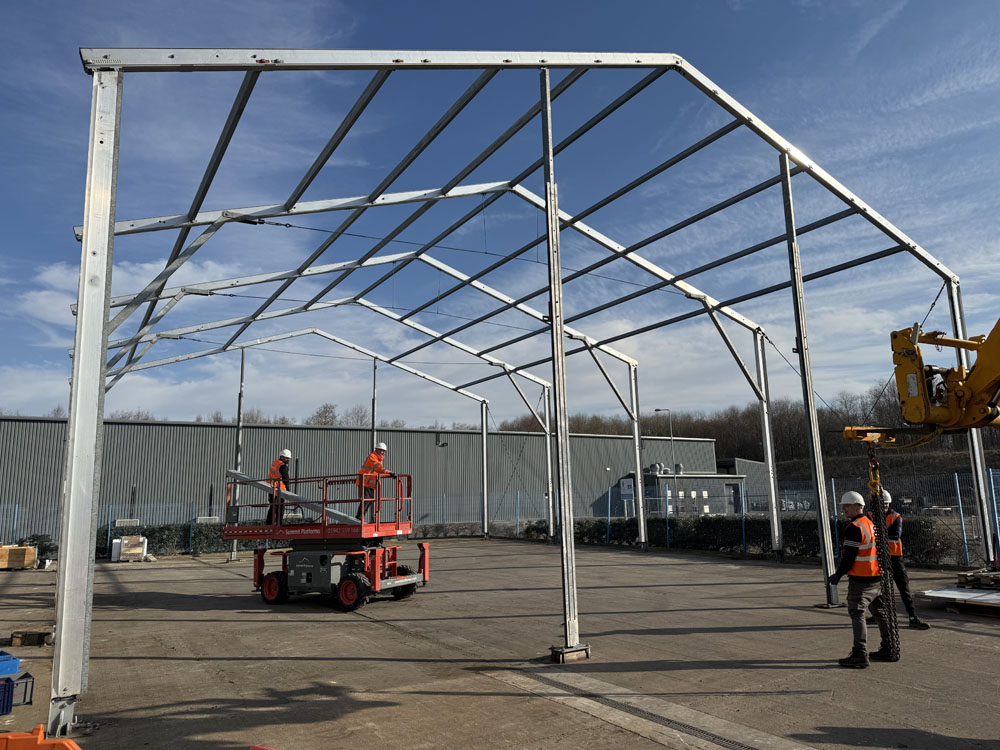
1. Concrete Anchors (for concrete floors)
Bolt anchors or expansion anchors are drilled and fixed directly into the concrete slab.
Bolt anchors can be used for cracked and non-cracked concrete depending on depth. The anchors are made from highly corrosion-resistant steel. They safely introduce the loads into the base material through friction locking. The installation method also saves time.
Pros:
- Ideal for semi-permanent setups.
- Offers strong resistance to wind uplift and lateral loads.
- Very quick installation.
Cons:
- It is best to have concrete a minimum depth of 300mm.
2. Ground Anchors or Earth Pins (for block-paving, asphalt, gravel)
These are used for ground surfaced with block-paving, asphalt or compacted gravel/scalpings subject to survey. These anchors are driven through the base plates we use and are suitable for softer surfaces.
Pros:
- Simple installation.
- Very little ground preparation needed, other than possibly compacting.
- Can be removed and reused, making them ideal for temporary structures.
Cons:
- Un-surfaced ground gives poorer surface inside for your forklift trucks and for racking.
- Ground survey recommended.
3. Ballast Weights (non-invasive method)
Concrete blocks, water tanks, or steel weights are used to weigh down the structure. They can be useful when ground penetration is not allowed (e.g., leased land or finely-paved surfaces). They much be used in conjunction with ratchet straps or chains as appropriate to meet structural calculations and windload. These are more likely to be used for very short term projects, from a day to a few weeks.
Pros:
- No damage to the surface.
- Quick to install and remove.
Cons:
- Takes up floor space.
- Needs correct weight calculations based on wind loads.
4. Asphalt Anchors
These are specialty anchors designed for use in asphalt surfaces (e.g., epoxy-set anchors). They can be less strong than concrete anchors, but viable for short-term installations.
Pros:
- Ideal for shorter-term requirements.
- Quick installation.
Cons:
- Ground survey recommended.
Key Considerations:
Wind Load: Ensure anchoring, and overall structure design, can resist expected wind speeds per locality. This is especially important for locations near to shorelines and those at high elevation.
Soil Type: For ground anchors, confirm soil suitability (sand, clay, rock).
Permissions: Local regulations may dictate or restrict certain methods.
Structure Type: Check manufacturer recommendations for anchoring systems.
When you get in touch to discuss the temporary building you need, we will ask about where it will be situated, so we can start thinking about the best way to secure the building. We always do a site survey and we will confirm the surface type during this visit, so we make absolutely sure we are recommending the right solution.